 HR, payroll & employment
Tax Codes Explained for 2026-27: Numbers, Letters, K Codes and Week 1/Month 1
UK tax codes for 2026-27 explained: what 1257L means, every letter, K, BR, D0 and 0T codes, Scottish S and Welsh C prefixes, W1/M1 and worked payroll examples.
 Edited by Sumeet YadavFounder & editor, MSMETOOLS · fact-checked against official sources
Contents (10)
- 1. What a tax code is and how the number works
- 2. Tax code letters and what each one means
- 3. K codes: when the code adds to your pay
- 4. BR, D0, D1, 0T and NT: codes with no allowance
- 5. Scottish and Welsh tax codes: the S and C prefixes
- 6. Cumulative vs week 1/month 1: how the payroll uses your code
- 7. Why your tax code changes and how to check it
- 8. How HMRC collects underpaid tax through your code
- 9. Employers: applying tax codes in payroll
- 10. What to do next
Your tax code is the short string of numbers and letters that tells your employer or pension provider how much of your pay to leave untaxed and which rates to use on the rest. Get it right and the tax on each payslip adds up to the correct bill for the year. Get it wrong and you can pay hundreds of pounds too much or end up owing HMRC. This guide decodes UK tax codes for the 2026-27 tax year for employees and for small employers running payroll: what 1257L means, every letter, K codes, BR, D0 and 0T, the Scottish and Welsh prefixes, and the difference between cumulative and week 1/month 1, with worked examples.
Quick answer
Most people with one job have the code 1257L: the number is your tax-free pay divided by 10 (£12,570) and the L means the standard Personal Allowance. Letters and prefixes change how the code works: S and C mark Scottish and Welsh taxpayers, K adds untaxed income to your pay, and BR, D0, D1 and 0T tax every pound with no allowance.
Codes ending W1, M1 or X are non-cumulative (emergency) codes: each payday is taxed on its own
A K code can never take more than 50% of your pay in a pay period
Check your code in HMRC's online service or app; HMRC tells your employer of a change within 15 working days
Employers must use the code HMRC sends, before the next payday, and never carry W1/M1 into a new tax year
The Personal Allowance is frozen at £12,570 until 5 April 2031, so 1257L stays the default
What a tax code is and how the number works
HMRC gives a tax code to each job or pension you have, not to you as a person. If you have two jobs, you have two codes, and each employer only sees its own. The code tells the payroll how much tax-free pay to allow in each pay period and whether any special rate applies.
To build the number, HMRC starts with your Personal Allowance of £12,570, adds any extra allowances you're entitled to (Marriage Allowance received, some job expenses) and subtracts income it wants to collect through your wages: company benefits such as medical insurance or a car, untaxed savings interest above your Personal Savings Allowance, the High Income Child Benefit Charge, State Pension (which is paid without tax) and tax owed from an earlier year. It then knocks the last digit off and adds a letter.
HMRC's own example is a £1,570 medical insurance benefit. That leaves £11,000 of tax-free allowance, so the code becomes 1100L. For payroll purposes, an L code gives a tiny bit more than the number times ten: PAYE tables treat 1257L as £12,579 of free pay a year (£1,048.25 a month), because the code drops the final digit and the tables add 9 back to avoid short-changing anyone.
Your allowance is reduced if your adjusted net income is above £100,000. You lose £1 of allowance for every £2 above that limit, and HMRC reflects this in a lower code once it knows your estimated income. That is one reason a high earner's code can drop part way through the year after a bonus or pay rise.
Because the Personal Allowance is frozen at £12,570 until 5 April 2031, the standard code for a single job or pension has been 1257L since April 2021 and will stay there for several more years. If yours is anything else, there is a reason, and it's worth knowing what it is.
Tax code letters and what each one means
The letter at the end, or a code made only of letters, tells the payroll how to treat the number. The letters HMRC uses for 2026-27 are:
| Code or letter | What it means | Where you usually see it |
|---|---|---|
| L | Standard tax-free Personal Allowance | Most people with one job or pension |
| M | You receive 10% of your spouse's or civil partner's allowance through Marriage Allowance | 1383M (£12,570 plus £1,260) |
| N | You've transferred 10% of your allowance to your partner | 1131N |
| T | Other calculations are included in your allowance, or HMRC is reviewing items with you | Often after a change in income above £100,000 |
| 0T | No tax-free allowance: it's used up, or a new employer has no details to work out a code | New job without a P45, payments after leaving |
| BR | All pay taxed at the basic rate (20%) | Second job or second pension |
| D0 | All pay taxed at the higher rate (40%) | Second job when the main job already uses the basic rate band |
| D1 | All pay taxed at the additional rate (45%) | Second income for very high earners |
| NT | No tax deducted from this income | Rare: some non-residents and specific cases |
| K | Untaxed income or deductions are more than your allowance | Company car, State Pension, old debts |
| S prefix | Scottish rates apply | Main home in Scotland |
| C prefix | Welsh rates apply | Main home in Wales |
The M and N codes are a pair. Marriage Allowance lets a non-taxpayer pass £1,260 of their allowance to a basic-rate partner, so the receiver's code goes up by 126 and gains an M, while the giver's code goes down by 126 and gains an N.
The flat-rate codes (BR, D0, D1, and their Scottish and Welsh versions) don't contain any allowance. They exist because the Personal Allowance can only be used once. If your main job already uses your allowance and basic rate band, a second job has to pay tax at the rate your next pound of income would attract, so HMRC gives it a flat-rate code.
K codes: when the code adds to your pay
A K code reverses the usual logic. Instead of giving you tax-free pay, it adds an amount to your taxable pay because the income HMRC needs to tax through your wages is bigger than your allowance. The most common reasons are a high-value company car or other benefits in kind, the State Pension being taxed through a private or workplace pension, and an underpayment from an earlier year being collected through your code.
The number works the same way in reverse. HMRC's employer guide uses K475 on a £27,000 salary: multiply 475 by 10 and add £4,750 to the pay, so tax is worked out as though the person earned £31,750. With no Personal Allowance in that calculation, all £31,750 falls in the basic rate band, giving about £6,350 of tax for the year, or £529 a month. On 1257L the same salary would attract about £2,886 a year, so the K code collects roughly £3,464 extra, which is the tax on the benefits or other income it's covering.
The safeguard is the regulatory limit. Tax deducted under a K code can't be more than 50% of the pay in that pay period. HMRC's PAYE guidance for employers says this overriding limit has applied to every tax code since April 2015, not only K codes. In the example, monthly pay is £2,250, so up to £1,125 could be taken, and the K code doesn't come close. It matters for people with small pay and large benefits, or pensioners whose private pension is small compared with the State Pension being collected through it. If the limit stops some tax being collected, HMRC deals with the shortfall after the year ends. HMRC's own coders are told not to issue a K code that would hit the limit if they can avoid it.
K475 on a £27,000 salary (2026-27, England)
+£4,750
Added to taxable pay
475 × 10
£31,750
Pay taxed for the year
no Personal Allowance
£529
Tax a month
vs about £240 on 1257L
50%
Maximum share of pay taken
£1,125 of £2,250
If you see a K code you don't expect, check the company benefits listed in your HMRC account. A car you've handed back, private medical cover that has ended, or a benefit counted twice are common errors. Once corrected, your employer receives a new code and the payroll refunds any overpaid tax on the next cumulative payday.
BR, D0, D1, 0T and NT: codes with no allowance
These codes all mean the same thing in one respect: no tax-free pay at all. The difference is the rate. BR taxes everything at 20%, D0 at 40% and D1 at 45%. A second job paying £800 a month on BR loses £160 a month in tax; on D0 the same job would lose £320.
0T works differently. It gives no allowance, but it isn't a flat rate. The payroll still applies the normal bands, so pay is taxed at 20% up to the basic rate limit for the period and at higher rates above it. 0T is used when a new starter can't or won't fill in a starter checklist, for payments made after a P45 has been issued, and sometimes when your allowance has been used up by other income or the £100,000 taper.
NT means no tax at all from that source. It's rare and used in specific circumstances, such as some people working abroad or certain pension arrangements. If you think you've been given BR or 0T wrongly on your only job, the P45 or starter checklist is usually the cause. Our emergency tax code guide covers how to fix that, and the P45 guide explains the starter checklist statements.
A common question is whether you can split your allowance between two jobs. You can. If your main job pays less than £12,570 a year, part of the allowance is wasted on it while the second job pays BR on every pound. Ask HMRC, through the online service or by phone, to move the unused part to the second job. The second job's code then becomes a number with an L, and the first job's code shrinks to match.
Scottish and Welsh tax codes: the S and C prefixes
Where you pay income tax on earnings depends on where your main home is, not where your employer is based. HMRC decides who is a Scottish or Welsh taxpayer from the address it holds, and adds the prefix. So a Glasgow resident working for a London company has an S code, and someone who lives in Chester but works in Wrexham doesn't have a C code.
Scottish taxpayers pay six rates on earnings, set by the Scottish Parliament. For 2026-27 the bands above the Personal Allowance are:
Scottish codes and bands for 2026-27 (total income)
| Band | Rate | Income band | Flat-rate code |
|---|---|---|---|
Starter | 19% | £12,570 to £16,537 | — |
Basic | 20% | to £29,526 | SBR |
Intermediate | 21% | to £43,662 | SD0 |
Higher | 42% | to £75,000 | SD1 |
Advanced | 45% | to £125,140 | SD2 |
Top | 48% | above £125,140 | SD3 |
Starter
- Rate
19%
- Income band
£12,570 to £16,537
- Flat-rate code
—
Basic
- Rate
20%
- Income band
to £29,526
- Flat-rate code
SBR
Intermediate
- Rate
21%
- Income band
to £43,662
- Flat-rate code
SD0
Higher
- Rate
42%
- Income band
to £75,000
- Flat-rate code
SD1
Advanced
- Rate
45%
- Income band
to £125,140
- Flat-rate code
SD2
Top
- Rate
48%
- Income band
above £125,140
- Flat-rate code
SD3
Scottish rates only apply to earnings and pensions. Savings and dividend income are taxed at UK rates wherever you live, and National Insurance is the same across the UK. That's why a Scottish higher-rate taxpayer still pays employee National Insurance at the same thresholds as everyone else, even though their income tax bands are different.
A worked comparison for a £30,000 salary shows how the S prefix changes the bill. On S1257L, the first £3,967 above the allowance is taxed at 19% (£753.73), the next £12,989 at 20% (£2,597.80) and the last £474 at 21% (£99.54): about £3,451 in total. On 1257L in England, all £17,430 above the allowance is taxed at 20%: £3,486. At this salary a Scottish taxpayer pays about £35 less a year, while higher up the scale the Scottish bill becomes larger because the 42% rate starts at a lower income.

Welsh taxpayers have a C prefix: C1257L, C0T, CBR, CD0 and CD1. The Senedd can vary Welsh rates, but for 2026-27 they match the rest of the UK, which is why HMRC's employer rates table groups England, Northern Ireland and Wales together. A Welsh code produces the same deductions as an English one on the same pay; the prefix is there so HMRC knows how much of the tax belongs to the Welsh Government.
If you move between Scotland and the rest of the UK, update your address with HMRC. Your status for the whole tax year depends on where you lived for the most days, and the prefix on your code follows the address HMRC holds. An out-of-date address is the most common reason for a missing or unwanted S prefix.
Cumulative vs week 1/month 1: how the payroll uses your code
The letters after the code matter as much as the code itself. A plain code such as 1257L is operated on a cumulative basis. Each payday the payroll adds up your pay since 6 April, works out your tax-free pay to date (one twelfth of the annual figure for each month that has passed), calculates the tax due on the difference and subtracts the tax already deducted. Anything overpaid comes back on the next payslip; anything underpaid is collected.
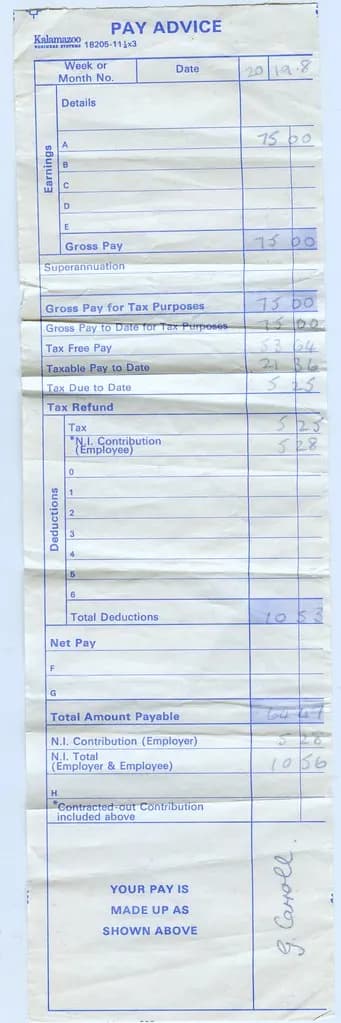
A code ending in W1 (weekly paid), M1 (monthly paid) or X (irregular pay dates) is non-cumulative, sometimes shown on payslips as NONCUM. Each period is taxed on its own: one week's or month's allowance against that period's pay, and no look back at earlier months. For 2026-27 the emergency codes are 1257L (W1/M1/X).
The difference shows up when something changes mid-year. Suppose Daniel earns £3,500 a month and is on 1257L for months 1 to 6, paying about £490.35 a month. In October HMRC adds a company car and his code becomes 1100L.
| Month 7 (October) | 1100L cumulative | 1100L M1 |
|---|---|---|
| Tax-free pay used | 7 months at 1100L: about £6,421.92 | One month: about £917.42 |
| Pay used in the calculation | £24,500 (April–October) | £3,500 (October only) |
| Tax for the month | About £673.52 | About £516.52 |
| What happens to the £157 shortfall from months 1–6 | Collected in October | Left for HMRC to collect after the year ends |
On the cumulative code, October's payslip catches up the extra £26.17 a month that should have been taken since April, so the year ends square. On month 1, Daniel pays the right rate from October onwards but carries an underpayment that HMRC will either code out next year or put on a P800 calculation. That's why HMRC sometimes deliberately issues a mid-year code on a month 1 basis: it avoids a sudden large deduction when a correction would hit a single payslip hard.
The reverse also happens. If you start work part way through the year after time off, a cumulative code gives you the unused allowance from the months you weren't earning, which can mean little or no tax for a month or two. On month 1 you don't get it until the year ends. The P45 guide has a worked example of that gap for a new starter.
Why your tax code changes and how to check it
HMRC changes a code whenever it needs to collect a different amount. GOV.UK lists the usual triggers: starting a new job, starting taxable state benefits, income from an extra job or pension, savings interest above your Personal Savings Allowance of £1,000 as a basic-rate taxpayer, a change in your State Pension, your employer reporting a new or ended company benefit, claiming Marriage Allowance or job expenses, paying the High Income Child Benefit Charge through your wages, and tax owed from being on the wrong code.
You'll see your code on every payslip, in the HMRC app, in the Check your Income Tax service (part of your HMRC personal tax account) and on any Tax Code Notice letter. HMRC may send the notice by email if you've opted for paperless.
How to check and fix your tax code
- 1
Find the code
Look at your latest payslip or sign in to the HMRC app. Note the code for each job or pension and whether it ends in W1, M1 or X.
- 2
Check the details behind it
In Check your Income Tax, review your employers and pensions, your estimated income for the year, company benefits and any expenses claimed. The estimated income drives how your allowance is split.
Tip: An estimate that's far too high or too low is the commonest cause of a strange code, especially after a pay rise, bonus or a change of hours.
- 3
Update anything wrong
Check your Income TaxChange the estimated pay, remove an old employer or benefit, or claim job expenses online.
- 4
Wait for the new code
HMRC should tell you and your employer within 15 working days. If you've just started a new job, give HMRC 35 days to sort the code before contacting them.
- 5
Check the next payslip
On a cumulative code, any overpaid tax comes back automatically. On W1/M1, overpayments are refunded after the year ends or when HMRC switches the code back to cumulative.
Your employer can't change your code because you ask them to. Payroll must use the code HMRC sends, and only HMRC can issue a new one. If an employer is using an old code, check that HMRC's notice reached them; it sometimes goes to an agent or an unmonitored PAYE Online inbox.
How HMRC collects underpaid tax through your code
When you owe tax from an earlier year, HMRC normally adds it to your code so it's collected gradually over the following tax year. GOV.UK says this happens automatically if you're paid through PAYE, your income above the allowance is enough to cover it, and the amount is less than £3,000. The deduction in your code is the underpaid tax converted into an equivalent amount of income, so £300 owed by a basic-rate taxpayer reduces the allowance by £1,500 and turns 1257L into 1107L.
HMRC's internal PAYE manual sets the guardrails. It won't code out an underpayment of £3,000 or more, won't use a source of income that's too small, won't push a K code past the 50% limit, and won't code an amount that would double the tax normally deducted, unless you ask for it knowing the effect on your take-home pay. Larger amounts, or tax that can't come from wages, go on a Simple Assessment letter instead. Self Assessment filers can also ask for a balancing payment of less than £3,000 to be collected through their code if they file online in time.
Because the adjustment is spread over a year, it doesn't usually shock the payslip. But if you've changed jobs, make sure the new employer is the one HMRC treats as your main job; otherwise the coded debt can sit on a small second job where it's harder to collect.
Employers: applying tax codes in payroll
If you run payroll, HMRC sends you codes in three ways: on a new starter's P45 (or derived from the starter checklist), as in-year Tax Code Notices (sometimes still called P6 notices) when an employee's code changes, and as new-year notices between January and March. You'll find them in PAYE Online, through the PAYE Desktop Viewer or directly in your payroll software if it downloads coding notices.
The employer's tax code year
January to March
HMRC sends codes for the new tax year; apply them from the first payday on or after 6 April
6 April
Carry forward any unchanged code, but drop every W1 and M1 marker so everyone starts the year cumulative
Any time in year
Apply an in-year code notice before the employee's next payday
New starter
Use the P45 code or the starter checklist outcome; no information means 0T
Late notices
A code that arrives too late for the current year is used from the new tax year
Three mistakes cause most payroll tax code problems. The first is carrying a W1 or M1 marker into the new tax year; HMRC's guidance is clear that you must not. The second is keying a code in without its prefix, so a Scottish taxpayer is taxed at rUK rates for months. The third is ignoring a K code's regulatory limit when a payslip is unusually small, for example in the month of unpaid leave. Good payroll software handles all three automatically, but check after any manual import.
For a one-off check of a payslip line by line, our salary slip generator shows gross pay, tax and National Insurance in the format employees expect.
Official links
- Tax codes (employees)Letters, emergency codes, K codes, Scottish and Welsh codes
- Check your Income Tax for the current yearSee and update your code
- Tax codes: employer guideGetting and applying code notices
- Rates and thresholds for employers 2026 to 2027Emergency code, bands and NI thresholds
- Tax overpayments and underpaymentsP800, Simple Assessment, coding out
What to do next
If your code is 1257L with no marker and you have one job, there's nothing to do. If it isn't, use the table above to find the reason, then check the details behind it in your HMRC account. If you've just started a job on an emergency code, read our emergency tax code guide for how quickly it should change and how the overpaid tax comes back. Employers can pair this with the P45 and P60 guides, and the benefits in kind guide explains the benefits that most often turn a code into a K code.
This is general information, not legal or tax advice — confirm on the official source or with a professional.
Frequently asked questions
1257L is the standard code for someone with one job or pension in the 2026-27 tax year. The number 1257 means £12,570 of tax-free pay, which is the standard Personal Allowance, and the L means you get the ordinary allowance with no adjustments. Pay above that is taxed at the normal rates for where you live in the UK.
A K code means the income HMRC needs to tax through your wages is more than your tax-free allowance. Typical reasons are a company car, the State Pension, or tax owed from an earlier year. Your employer adds the K amount to your pay before working out tax, but can never deduct more than half your pay in any period.
1257L on its own is cumulative: each payday the payroll looks at your pay and tax since 6 April, so unused allowance from earlier months is given back. 1257L M1 (or W1) is non-cumulative: each month is taxed on its own as if it were a twelfth of your year, so any underpaid or overpaid tax from earlier months isn't corrected until HMRC changes the code or the year ends.
Not necessarily. BR is the normal code for a second job or a second pension, because your Personal Allowance is usually used by your main job. Every pound from that job is taxed at the basic rate. If this is your only job, or your main job pays less than £12,570 a year, ask HMRC to move some allowance to it.
Sign in to HMRC's Check your Income Tax service or the HMRC app, check your employers, estimated income, company benefits and expenses, and correct anything wrong. HMRC should tell you and your employer about the new code within 15 working days. Your employer can't change the code on your say-so; it must wait for HMRC's notice.
Yes. Scottish taxpayers have codes starting with S (for example S1257L) and pay Scottish rates on earnings. Welsh taxpayers have codes starting with C (for example C1257L). Welsh rates currently match those in England and Northern Ireland, so the C mainly shows that part of the tax goes to the Welsh Government. Which applies depends on where your main home is.
Sources & verification
Figures on this page were checked against the sources below when it was last reviewed on 12 October 2026. Each rate and limit is stored once with its own official source and review date, and official update channels are monitored daily so changes are picked up. How we verify
- 1.Tax codes (full guide) — HMRC / GOV.UK · accessed 12 October 2026
- 2.Tax codes: employer guide — HMRC / GOV.UK · accessed 12 October 2026
- 3.Rates and thresholds for employers 2026 to 2027 — HMRC · accessed 12 October 2026
- 4.2026 to 2027: Employer further guide to PAYE and NICs (CWG2) — HMRC · accessed 12 October 2026
- 5.PAYE Manual PAYE11095 — K codes — HMRC · accessed 12 October 2026
- 6.PAYE Manual PAYE12070 — coding underpayments — HMRC · accessed 12 October 2026
- 7.Tax overpayments and underpayments — HMRC / GOV.UK · accessed 12 October 2026
- 8.50% overriding limit for PAYE tax deductions — CIPP · accessed 12 October 2026
MSMETOOLS is an independent platform and is not affiliated with any government agency, ministry or department.
Tools for this
Salary Slip Generator
Create professional salary slips in seconds.
Budget Planner
Plan and track your business budget easily.
Related guides
 Emergency Tax Code 2026: 1257L W1/M1, Refunds & How LongRead guide
 P45 Explained 2026: When to Issue It, Parts & No-P45 StartersRead guide
 P60 Explained 2026: Deadline, What It Shows & Lost P60sRead guide
 Right to Work Checks 2026: Share Codes, IDVT & PenaltiesRead guide
Official links open the government site in a new tab.