 HR, payroll & labour
Minimum Wages in Tamil Nadu (2026): Shop Rates by Zone, the April DA and Worked Payroll
Tamil Nadu minimum wages 2026: shop and establishment rates for Zones A–D with the ₹7,353 DA from 1 April 2026, how the DA is worked out, and ₹ payroll examples.
 Edited by Sumeet YadavFounder & editor, MSMETOOLS · fact-checked against official sources
- Rates in force
- 1 April 2026 – 31 March 2027
- Last checked
- Against the official source on 9 October 2026
- Next revision due
- 1 April 2027
Contents (12)
- 1. How Tamil Nadu's minimum wage system is structured
- 2. Shops and commercial establishments: rates for 2026-27
- 3. Which zone is your business in?
- 4. How the April DA is calculated
- 5. DA in other common MSME employments
- 6. Security guards: two different schedules
- 7. Daily rates, overtime and part-month pay
- 8. Worked payroll examples in ₹ (2026-27)
- 9. Tamil Nadu minimum wages under the Code on Wages
- 10. Common mistakes Tamil Nadu employers make
- 11. What happens if you underpay
- 12. What to do next
If you run a textile shop in Chennai, a pharmacy in Madurai, a hardware store in a Tiruppur municipality or a small security agency in Coimbatore, Tamil Nadu sets the least you can pay through a two-part system: a basic wage fixed by a Government Order for your type of business, and a dearness allowance (DA) that the Commissioner of Labour recalculates every April. Most pages online quote only the DA, which leaves you guessing at the total. This guide puts both halves together for shops and commercial establishments, checked against the Labour Department's own orders, then shows the zones, the DA arithmetic, other common employments and worked payroll in rupees.
Quick answer
From 1 April 2026, a shop assistant, helper or peon in a Tamil Nadu shop or commercial establishment must get at least ₹14,044 a month in Zone A (corporations and special-grade municipalities) and ₹13,823 in Zone D (villages). That is the basic wage under G.O.(2D) No.65 of 2024 plus a DA of ₹7,353 a month under the Commissioner of Labour's statement No. Z3/3459/2026 dated 18 February 2026.
Each scheduled employment has its own G.O. — shops, security, hotels, tailoring and so on
DA is revised every 1 April from the average Chennai City CPI; current DA runs to 31 March 2027
Daily rate = monthly wage ÷ 26 — ₹540.15 for a Zone A helper
Four zones for shops (A–D); some other employments use three
How Tamil Nadu's minimum wage system is structured
Tamil Nadu does not publish one statewide rate. Under the Minimum Wages Act, 1948, the state notified a long list of "scheduled employments" — shops and commercial establishments, security guards, hotels and restaurants, tailoring, automobile workshops, printing presses, rice and flour mills, construction, domestic work and dozens more — and fixed minimum wages for each one through a separate Government Order (G.O.) issued by the Labour Welfare and Skill Development Department. Each G.O. sets basic wages for named job titles, often split by zone, and a formula for the dearness allowance.
Every G.O. links its DA to the average consumer price index (CPI) for Chennai City in a stated base year, usually 161 points for 2010 on the 2001=100 series, and gives a rupee amount per point. Once a year, the Office of the Commissioner of Labour in Chennai publishes a single statement listing the DA payable in every scheduled employment. For 2026-27 that statement is No. Z3/3459/2026 dated 18 February 2026, effective from 1 April 2026 to 31 March 2027, and it covers more than 70 employments.
So the minimum wage you must pay is always basic wage from the latest G.O. for your employment + DA from the latest Commissioner's statement. The basic part changes only when the government revises that employment's G.O., which happens every few years and at different times for each sector. The DA part changes every April for most employments. A handful of sectors work differently: the 2026 statement notes that DA for plantations is calculated every three months, for cashew every six months, and for leather goods and footwear every month.
Tamil Nadu shops & establishments at a glance (2026-27)
₹14,044
Helper / shop assistant, Zone A
per month, basic + DA
₹13,823
Helper / shop assistant, Zone D
₹7,353 a month
DA from 1 April 2026
same in all zones
344 points
Average Chennai CPI, 2025
base 2001=100
Shops and commercial establishments: rates for 2026-27
The shops schedule is the one most small businesses fall into. It covers retail and wholesale shops, offices, showrooms, godowns, pharmacies, salons, photo studios, optical and repair shops, chit funds, lodges, furniture shops, petrol bunks and general workers in any commercial establishment. The current basic wages come from G.O.(2D) No.65, dated 20 August 2024, which took effect on publication in the gazette (the Commissioner's statement records 11 September 2024) and superseded the 2019 rates.
The table adds the ₹7,353 a month DA to each basic wage. The DA is the same in every zone and for every job, so the differences between cells come entirely from the basic wage.
| Job group (examples from the G.O.) | Zone A | Zone B | Zone C | Zone D |
|---|---|---|---|---|
| Manager, sales manager, field officer, development officer, office in-charge | ₹14,743 | ₹14,681 | ₹14,617 | ₹14,567 |
| Assistant manager, accountant, supervisor, sales executive, purchaser, store keeper | ₹14,233 | ₹14,168 | ₹14,106 | ₹14,044 |
| Cashier, clerk, typist, stenographer, salesman, sales representative, bill writer | ₹14,182 | ₹14,106 | ₹14,033 | ₹13,972 |
| Bill collector, godown keeper, assistant salesman, receptionist, security guard, driver | ₹14,120 | ₹14,044 | ₹13,972 | ₹13,906 |
| Peon, watchman, shop assistant, helper, packer, delivery boy, sweeper, gardener | ₹14,044 | ₹13,972 | ₹13,894 | ₹13,823 |
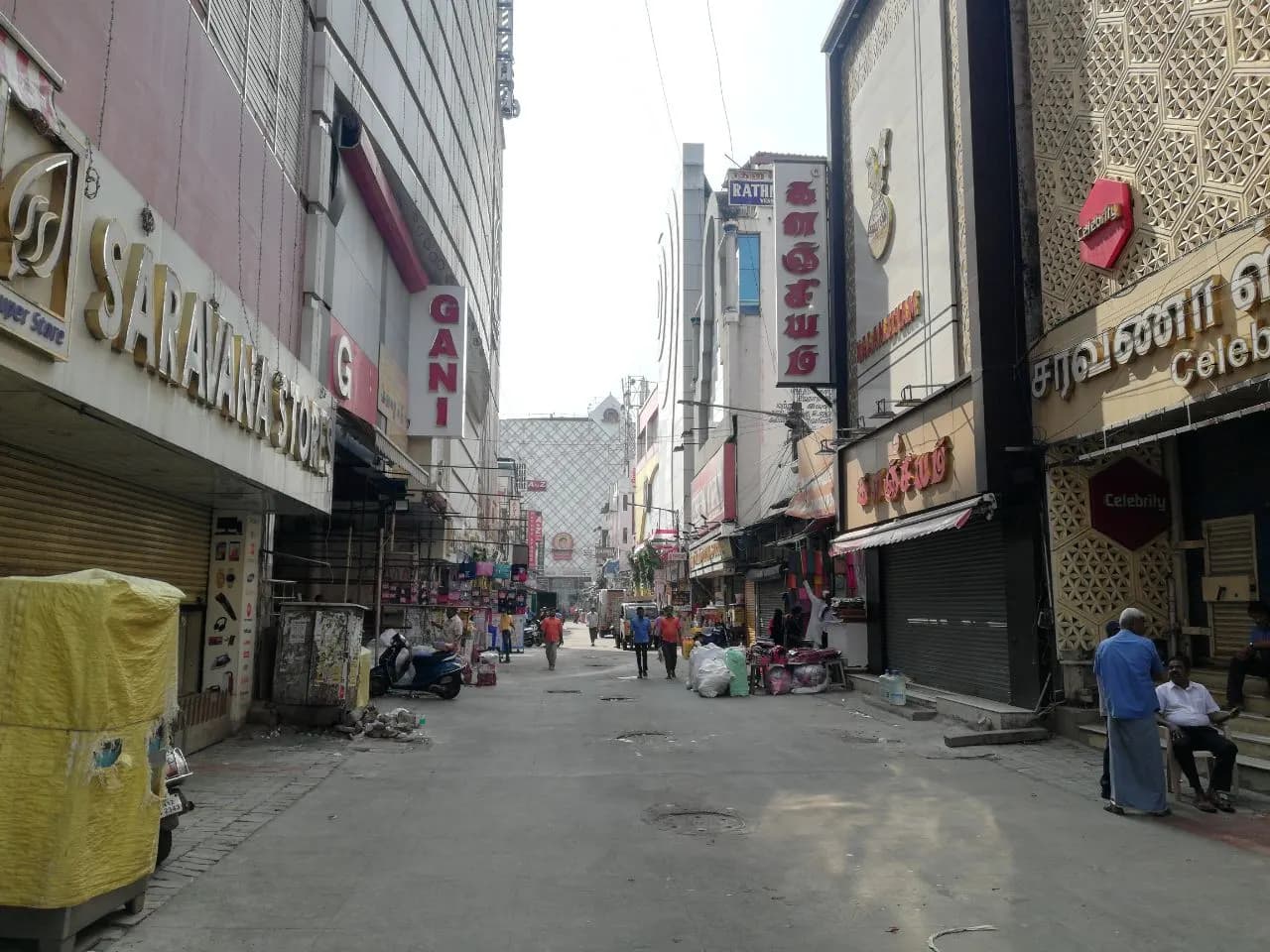
The special categories in the same G.O. slot into these five pay levels. Pharmacists and chemists in medical shops get the manager rate; compounders get the cashier rate. Hairdressers and beauticians in salons and parlours, watch and radio mechanics, optical mechanics, engravers, chit-fund accountants, carpenters and polishers in furniture shops get the assistant-manager rate (salons have a slightly lower Zone D basic of ₹6,675). Photographers, electricians, lab technicians and radiographers in diagnostic laboratories get the cashier rate. Room boys in lodges, bicycle fitters, petrol-bunk operators, loaders in godowns and "general workers" not covered elsewhere get the helper rate. When a job is not listed by name, the catch-all for general workers outside the administrative and clerical cadre means the helper rate is the floor.
Two other lines in the G.O. matter in practice. Men and women doing the same work must be paid the same, and if you already pay more than the new minimum you must keep paying the higher wage — you cannot cut a salary down to the notified figure.
Tamil Nadu minimum wage calculator
A full month is 26 working days; the daily rate is the monthly rate ÷ 26 where the order fixes only a monthly figure.
Overtime is paid at twice the ordinary rate (daily rate ÷ 8 hours). Arrears assume the same shortfall in every month since the rates took effect on 1 April 2026; a claim under the Code on Wages must generally be filed within 3 years. Estimates only — check the order for your employment.
Which zone is your business in?
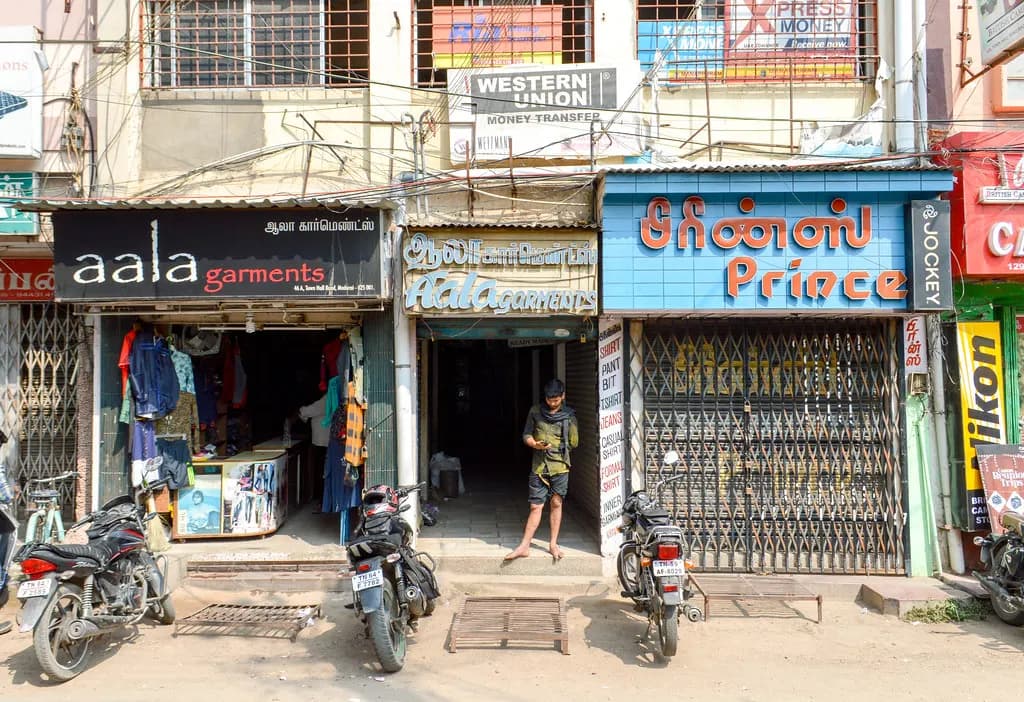
The zone depends on the local body where the employee works, not where your head office or GST registration is. For shops and commercial establishments the G.O. defines four zones:
- Zone A — all municipal corporations (Chennai, Coimbatore, Madurai, Tiruchirappalli, Salem, Tirunelveli, Tiruppur, Erode, Vellore and the newer corporations) and all special-grade municipalities.
- Zone B — every other municipality.
- Zone C — townships, town panchayats and cantonments.
- Zone D — everywhere else, which in practice means village panchayat areas.
Tamil Nadu has upgraded a number of towns to corporation or municipality status in recent years, so check the current status of your local body rather than relying on an older list. If a town became a corporation, its shops move into Zone A from the date the change took legal effect.
The gap between zones is small for shops — about ₹221 a month between Zone A and Zone D for a helper — because the DA, which is identical everywhere, now makes up more than half the wage. Other employments use their own zone definitions. The security guards G.O., for example, has three zones: Zone A for municipal corporations, Zone B for all municipalities and Zone C for everything else.
How the April DA is calculated
The DA formula is printed in each G.O. For shops, Explanation 1 of G.O.(2D) No.65 says the DA is linked to the average Chennai City CPI for 2010 — 161 points on the 2001=100 series — and that every one-point rise above 161 adds ₹40.18 a month per point. The DA is recalculated each year on 1 April using the average of the twelve monthly indices for the preceding January to December.
The 2026 statement records that the average Chennai City index for calendar year 2025 was 344 points. The arithmetic for shops is therefore:
- Points above base: 344 − 161 = 183 points
- DA: 183 × ₹40.18 = ₹7,352.94, rounded to ₹7,353 a month
The same 183 points apply to every employment that uses the 161-point base, which is most of them. What differs is the rupee value per point fixed in each G.O. Security guards get ₹56.00 a point, so their DA is ₹10,248 a month; automobile workshops get ₹56.29, giving ₹10,301 a month; hotels and restaurants get ₹46.26, giving ₹8,466 a month.
A few newer G.O.s use a later base. Tailoring and private hospitals were revised against the 2013 average of 218 points, so only 126 points count, which is why their DA is lower — ₹4,276 a month for tailoring and ₹5,544 a month for hospitals and nursing homes. That doesn't mean those workers earn less overall; their basic wages were set higher to absorb the DA earned up to the newer base year.
You can budget for April 2027 the same way. Track the monthly Chennai City index published through 2026; if the calendar-year average ends, say, 8 points higher at 352, a shop's DA would rise by about 8 × ₹40.18 ≈ ₹321 a month. That is our estimate of the method, not an official projection.
DA in other common MSME employments
If your business is not a shop, find your own employment's G.O. on the Labour Department's minimum wages page, take the basic wage for the job and zone, and add the DA from the current statement. The table shows the 2026-27 DA for some employments small businesses often fall into. These DA figures are not total wages — add the basic wage from the relevant G.O.
| Scheduled employment | G.O. (effective) | DA per point | DA from 1 April 2026 |
|---|---|---|---|
| Shops and commercial establishments | (2D) No.65 (11.09.2024) | ₹40.18 | ₹7,353 a month |
| Security guards (agencies) | (2D) No.81 (23.10.2024) | ₹56.00 | ₹10,248 a month |
| Hotels and restaurants | (2D) No.35 (13.08.2014) | ₹46.26 | ₹8,466 a month |
| Automobile workshops | (2D) No.98 (06.11.2024) | ₹56.29 | ₹10,301 a month |
| Printing presses | (2D) No.48 (06.07.2022) | ₹34.75 | ₹6,359 a month |
| Tailoring industry | (2D) No.29 (31.05.2024) | ₹33.94 | ₹4,276 a month |
| Private hospitals and nursing homes | (2D) No.21 (11.06.2025) | ₹44.00 | ₹5,544 a month |
| Construction, roads and building operations | (2D) No.94 (07.12.2022) | ₹2.69 a day | ₹492.30 a day |
Some employments, like construction, rice mills and timber, are fixed per day rather than per month, so their DA is also a daily amount. The hotels G.O. dates from 2014 and its basic wages are old; the DA has carried most of the increase since then. The most recently revised employments on the department's list are salt pans (G.O. dated 30 September 2025) and handmade paper and beedi rolling (both dated 7 November 2025).
Security guards: two different schedules
Security is the area where Tamil Nadu employers most often pay the wrong rate. The shops G.O. lists "security guard" in its bill-collector and driver group, so a guard on a shop's or office's own payroll gets ₹14,120 a month in Zone A.
Guards employed by security agencies are covered by a separate scheduled employment — "Employment in Security Guards" — revised by G.O.(2D) No.81 of 19 September 2024. Its basic wage for a security guard is ₹9,915 in Zone A, ₹9,471 in Zone B and ₹9,031 in Zone C, and its DA is ₹10,248 a month. Basic plus DA comes to:
| Security guards schedule | Zone A (corporations) | Zone B (municipalities) | Zone C (other areas) |
|---|---|---|---|
| Security guard (male/female), per month | ₹20,163 | ₹19,719 | ₹19,279 |
That is around ₹6,000 a month more than the shops-schedule guard. If you hire guards through an agency, your contract rate needs to cover at least this wage plus the agency's EPF, ESI, bonus and margin. As principal employer you remain answerable if the agency underpays, so ask for wage registers and challans each month.
Daily rates, overtime and part-month pay
Tamil Nadu's monthly figures are the starting point. The shops G.O. says that to arrive at a daily rate you divide the monthly wage by 26, so a Zone A helper's daily minimum is ₹540.15 and a Zone D helper's is ₹531.65. Use the daily rate for casual and daily-rated staff and for working out pay when someone joins or leaves mid-month.
For overtime, the Code on Wages requires twice the normal rate of wages. Dividing the daily rate by an eight-hour day gives the ordinary hourly rate — ₹67.52 for a Zone A helper — so each overtime hour costs at least ₹135.04. Overtime is paid on top of the minimum and doesn't count towards meeting it.
Part-time staff should be paid in proportion to the hours they work, using the same hourly figure. Don't count employer EPF, ESI contributions, bonus or travel reimbursements towards the minimum; the minimum is the basic plus DA paid in cash to the worker.
Worked payroll examples in ₹ (2026-27)
Example 1 — a shop assistant in Chennai (Zone A). Revathi works as a shop assistant in a T. Nagar textile shop on the minimum wage, and in October 2026 she works 6 hours of overtime.
- Basic + DA: ₹14,044
- Overtime: ₹135.04 × 6 = ₹810.24
- Gross: ₹14,854.24
- ESI, since wages are below ₹21,000/month: employee share at 0.75% ≈ ₹111.41; employer share at 3.25% ≈ ₹482.76
- EPF at 12% of wages on basic + DA of ₹14,044 (overtime excluded): ₹1,685.28 from her, the same from you
- Net pay ≈ ₹14,854.24 − ₹111.41 − ₹1,685.28 = ₹13,057.55
Chennai profession tax is levied per half-year. Her half-yearly income of about ₹84,264 is above ₹75,000, so the Greater Chennai Corporation rate is ₹1,250 per half-year, which employers usually deduct from August and January salaries — see our Tamil Nadu professional tax guide.
Example 2 — an accountant in a Zone B town. A wholesale shop in a non-special-grade municipality employs an accountant. The minimum is the assistant-manager group rate of ₹14,168 a month. If the shop already pays her ₹18,000, it keeps paying ₹18,000; the G.O. protects existing higher wages.
Working out the minimum for one Tamil Nadu worker
Step 1
Find your scheduled employment's G.O.
Step 2
Pick job group + zone
basic wage
Step 3
Add current DA
Commissioner's April statement
Step 4
÷ 26 for daily rate
÷ 8 for hourly
Step 5
Overtime 2×
on top
Step 6
Pay by the 7th with a wage slip
Example 3 — a casual helper in a village shop (Zone D). A helper is engaged by the day for 20 days in October. Minimum pay = 20 × ₹531.65 = ₹10,633.
Example 4 — an agency security guard in Coimbatore (Zone A). The guard works 26 shifts. The minimum is ₹20,163 a month. EPF at 12% on that is ₹2,419.56 each from guard and agency, since the wage is below the ₹25,000 a month ceiling. With a little overtime, the guard's gross can cross ₹21,000/month, but ESI coverage is decided by the wage at the start of each contribution period, so the agency should check its ESI records rather than drop the guard mid-period.
Example 5 — April catch-up. A shop in Salem kept paying its peon the 2025-26 rate in April 2026 because the new DA statement wasn't on file. The new DA applies from 1 April whatever the payroll system says, so the shop owes the difference for every month it underpaid and should show it as arrears on the next wage slip.
Tamil Nadu minimum wages under the Code on Wages
The Code on Wages, 2019 came into force on 21 November 2025 and repealed the Minimum Wages Act, 1948 and the Payment of Wages Act, 1936. Section 69 of the Code keeps existing notifications alive until they are replaced, so Tamil Nadu's G.O.s and the 2026 DA statement remain the binding rates. The Code also makes minimum wages a right of every employee, not only those in scheduled employments, so the old argument that "my trade isn't on the list" carries much less weight.
When we last checked, on 9 October 2026, the state Labour Department's Labour Codes page listed only the draft Code on Wages (Tamil Nadu) Rules, 2022, alongside the final central rules notified in 2026. Until Tamil Nadu finalises its own rules, expect inspectors to apply the Code's main duties together with the existing G.O.s.
The national floor wage provided for in section 9 of the Code had not been notified when we checked. Tamil Nadu's shop rates — over ₹530 a day even in Zone D — are already far above the old advisory National Floor Level Minimum Wage of ₹176 a day (advisory, 2017).
The Code's duties that matter most for payroll:
- Pay on time — monthly wages before the end of the 7th day of the next month; final dues within 2 working days after resignation, dismissal or retrenchment.
- Deductions — total deductions can't exceed 50% of wages.
- Equal pay — no difference between genders for the same or similar work.
- Contract workers — the principal employer is answerable for unpaid wages of a contractor's workers.
- Records and wage slips — keep registers and issue a wage slip every wage period.
Tamil Nadu minimum wage checklist for 2026-27
0/8Common mistakes Tamil Nadu employers make
Quoting only the DA. The ₹7,353 figure that circulates on social media is the DA alone. The minimum wage is that plus the basic wage for the job and zone.
Using the wrong employment's G.O. A hotel's own kitchen staff fall under hotels and restaurants, its in-house security guards may fall under shops, and a guard supplied by an agency falls under security guards. Classify by what the employer does and who employs the worker.
Forgetting the zone upgrade. When a municipality becomes a corporation, its shops move from Zone B to Zone A. The difference is small for shops but larger in employments where the basic wage is a bigger share.
Treating the 26-day divisor as a cap. A monthly-paid employee gets the full monthly wage whether the month has 30 or 31 days. The ÷26 rule converts to a daily rate; it doesn't let you deduct for Sundays.
Netting benefits against the wage. Food, uniforms, employer PF and ESI contributions don't reduce the cash minimum you owe.
What happens if you underpay
A worker, a group of workers or a union can file a claim for unpaid minimum wages under the Code on Wages within 3 years. The authority can award the shortfall plus compensation of up to 10 times the claim. Paying less than the minimum is also an offence, punishable with a fine of up to ₹50,000 for a first offence and up to ₹1 lakh fine and/or 3 months' imprisonment for a repeat within five years. Labour inspectors in Tamil Nadu routinely check the wage register against the current DA statement, so the April change is the first thing they look for.
If you find an underpayment, work out the difference from the date the higher rate applied, pay it as a separate arrears line and keep the calculation on file.
What to do next
Pull up the G.O. for your employment, set each employee's basic wage by job group and zone, add the ₹7,353 a month DA if you run a shop or the matching DA for your sector, and pay arrears if your April to September payroll used last year's figure. Then issue wage slips that show basic, DA, overtime, ESI and EPF on separate lines with our free salary slip generator. If you also employ people in Bengaluru, compare the Karnataka minimum wages, and read the Code on Wages guide for the wider rules on deductions and payment dates.
This is general information, not legal or tax advice — confirm on the official source or with a professional.
Frequently asked questions
Tamil Nadu fixes a separate minimum wage for each scheduled employment. For shops and commercial establishments, the most common MSME category, a helper, peon or shop assistant must get at least ₹14,044 a month in Zone A and ₹13,823 in Zone D from 1 April 2026. That is the basic wage under G.O.(2D) No.65 of 2024 plus a dearness allowance of ₹7,353 a month.
The Commissioner of Labour's statement No. Z3/3459/2026 dated 18 February 2026 fixes the dearness allowance for shops and commercial establishments at ₹7,353 a month from 1 April 2026. It is worked out as ₹40.18 a month per point for every point the average Chennai City consumer price index for 2025 (344 points) stood above the 2010 base of 161 points. It applies until 31 March 2027.
For shops and commercial establishments, Zone A is every municipal corporation and special-grade municipality, Zone B is every other municipality, Zone C covers townships, town panchayats and cantonments, and Zone D is everywhere else. Other employments can use different zones — the security guards notification, for example, has only three zones.
Divide the monthly figure, basic plus DA, by 26. The shops notification says so in terms. A Zone A shop assistant's daily minimum is therefore ₹540.15, and a Zone D helper's is ₹531.65. Daily-rated and casual workers must get at least that for each day they work.
It depends on who employs the guard. A guard on a shop's own payroll falls in the shops schedule and gets ₹14,120 a month in Zone A. Guards employed by security agencies fall under the separate Security Guards notification, G.O.(2D) No.81 of 2024, where basic plus DA comes to ₹20,163 in Zone A (corporations).
The DA for most scheduled employments is recalculated once a year, from 1 April, using the average Chennai City CPI for the previous January–December. The next revision is due on 1 April 2027. Basic wages change only when the government issues a fresh G.O. for an employment, which happens every few years per sector.
Sources & verification
Figures on this page were checked against the sources below when it was last reviewed on 9 October 2026. Each rate and limit is stored once with its own official source and review date, and official update channels are monitored daily so changes are picked up. How we verify
- 1.G.O.(2D) No.65 dated 20.08.2024 — revision of minimum rates of wages for employment in Shops and Commercial Establishments — Labour Welfare and Skill Development Department, Government of Tamil Nadu · accessed 9 October 2026
- 2.Statement of dearness allowance payable w.e.f. 01.04.2026 — No. Z3/3459/2026 dated 18.02.2026 — Office of the Commissioner of Labour, Chennai (scanned copy reproduced by Futurex Solutions) · accessed 9 October 2026
- 3.G.O.(2D) No.81 dated 19.09.2024 — revision of minimum rates of wages for employment in Security Guards — Labour Welfare and Skill Development Department, Government of Tamil Nadu · accessed 9 October 2026
- 4.Important G.O.s of Labour Department — minimum wages — Labour Department, Government of Tamil Nadu · accessed 9 October 2026
- 5.Labour Codes — central rules and draft Tamil Nadu rules — Labour Department, Government of Tamil Nadu · accessed 9 October 2026
- 6.The Code on Wages, 2019 (No. 29 of 2019) — India Code, Legislative Department · accessed 9 October 2026
- 7.Tamil Nadu Minimum Wages 2026: Zone-Wise Rates — Futurex Solutions · accessed 9 October 2026
- 8.Revision of minimum wages – Tamil Nadu – 18.02.2026 — Ascent HR · accessed 9 October 2026
MSMETOOLS is an independent platform and is not affiliated with any government agency, ministry or department.
Tools for this
Related guides
 Minimum Wages in Chhattisgarh 2026: Zone Rates, VDA & PayRead guide
 Minimum Wages in Goa 2026: Zone A & B Rates with VDARead guide
 Minimum Wages in Kerala 2026: Shop Rates, DA & PayrollRead guide
 Telangana Minimum Wages & VDA Points 2026: G.O.Ms.No.6 RatesRead guide
Official links open the government site in a new tab.