 GST/HST & sales tax
BC PST in 2026: Rates, Registration, Exemptions, Software and How to File
BC PST in 2026: the 7% rate, who must register, the C$10,000 small seller rule, software and services, MRDT on hotels, eTaxBC filing and worked GST + PST examples.
 Edited by Sumeet YadavFounder & editor, MSMETOOLS · fact-checked against official sources
Contents (10)
- 1. What BC PST is and how it differs from GST
- 2. BC PST rates in 2026: general, liquor, accommodation and vehicles
- 3. Who must register for BC PST
- 4. How to register for a PST number
- 5. What's exempt from BC PST
- 6. Software, digital services and telecommunications
- 7. Professional services: what changed on 1 October 2026 — and what was paused
- 8. Filing and paying your PST return
- 9. Common mistakes and how to fix them
- 10. What to do next
If you sell goods, software or certain services in British Columbia, you deal with two sales taxes: the federal GST and BC's own provincial sales tax. This guide is for owner-operators, bookkeepers and out-of-province sellers who need the BC PST rules in one place for 2026 — the rates, who has to register and who doesn't, the main exemptions, how software and services are treated, the MRDT on hotel rooms, how the eTaxBC return works, and the changes that took effect (and the one that didn't) on 1 October 2026. Every rule is checked against BC Ministry of Finance bulletins as of October 2026, with worked examples in Canadian dollars.
Quick answer
BC PST is a 7% retail sales tax charged on the price before GST, so most taxable sales in BC carry 12% in total (5% GST + 7% PST). You must register with the province if you sell or lease taxable goods or provide software, telecommunication, legal or related services in BC — unless you're a small seller with C$10,000 or less of taxable sales. You file through eTaxBC by the last day of the month after each period.
Special rates: liquor 10%, short-term accommodation 8% plus up to 3% MRDT, vehicles 7% to 20%
Out-of-province Canadian sellers register once BC sales pass C$10,000 in 12 months
Exempt: food, children's clothing, books, bicycles, prescription drugs, goods for resale
Software and SaaS are taxable; custom software is exempt
PST on accounting, engineering and other professional services was paused in September 2026 — not in force
What BC PST is and how it differs from GST
The Provincial Sales Tax (PST) is a retail sales tax levied under BC's Provincial Sales Tax Act and administered by the BC Ministry of Finance, not the Canada Revenue Agency. Unlike the GST, which applies to almost everything and is recovered by businesses through input tax credits, PST is designed to be paid once, by the final user. That's why the rules focus on retail sales: goods bought for resale, or bought to be incorporated into goods you will sell, are generally exempt when you give the seller your PST number.
The practical consequences are bigger than they look. First, there is no PST equivalent of an input tax credit. PST you pay on your own office furniture, computers or software is a real cost of doing business in BC. Second, PST applies to goods by default but to services only when the Act lists them. A plumber's repair of a dishwasher is a taxable "related service"; a marketing consultant's advice is not. Third, you register, file and pay separately from your GST/HST account — your BN and GST number do nothing for PST.
Both taxes are calculated on the same pre-tax selling price. The CRA is explicit that GST is calculated on the price without PST, and BC charges PST on the price without GST. On a C$1,000 taxable sale you therefore show C$50 GST and C$70 PST — never 7% of C$1,050.
BC sales tax rates at a glance (2026)
7%
General PST rate
goods, software, taxable services
10%
PST on liquor
8%
PST on short-term accommodation
plus MRDT up to 3%
12%
Typical combined GST + PST
5% GST + 7% PST
BC PST rates in 2026: general, liquor, accommodation and vehicles
The general rate is 7% and applies to most taxable goods, leases, software, telecommunication services, legal services and related services. Three categories use different rates.
Liquor is taxed at 10%. A restaurant bill therefore mixes rates: the food is PST-exempt (prepared food and restaurant meals are exempt from PST, though not from GST), soft drinks sold by a restaurant carry 7%, and the wine carries 10%. Point-of-sale systems need separate tax codes for each.
Short-term accommodation — hotel and motel rooms, B&Bs and short-term rentals — is taxed at 8%. In participating municipalities and regional districts, a Municipal and Regional District Tax (MRDT) of up to 3% is added; each area sets its own rate, and the province publishes a location map. Vancouver also levies an additional 2.5% Major Events MRDT until 31 January 2030. Stays of 27 days or more continuous days are exempt from both PST and MRDT. Your PST number doubles as your MRDT number, so there is no second registration.
Passenger vehicles bought from a dealer start at 7% under C$55,000 and step up through 8%, 9% and 10%, then to 15% from C$125,000 and 20% at C$150,000 and over. Zero-emission vehicles have a higher starting band (7% under C$75,000). Vehicles bought privately are taxed at 12% at lower prices, paid by the buyer when the vehicle is registered rather than collected by the seller.
As of October 2026 we found no change to the 7% general rate announced for 2026; the BC budget, usually tabled in February, is where a rate change would first appear.
Do you need a BC PST number?
Step 1
Sell taxable goods, software or listed services in BC?
Step 2
Located in BC? → small seller test (C$10,000, no shop)
Step 3
Outside BC? → over C$10,000 of BC sales, or soliciting BC customers
Step 4
Register on eTaxBC
before the first taxable sale
Who must register for BC PST
Registration duty depends on where your business is located and what you sell. Bulletin PST 001, revised in October 2026, sets out the tests.
If you're located in BC, you must register if, in the ordinary course of business, you sell or lease taxable goods in BC, sell accommodation, or provide legal services, online marketplace services, related services, software or telecommunication services. The Ministry treats a business as located in BC if it has a storefront, office, warehouse or other physical place of business here, has employees or agents physically here, or is managed and controlled from here. You can't legally make retail sales of taxable goods without a valid PST number once you meet these tests.
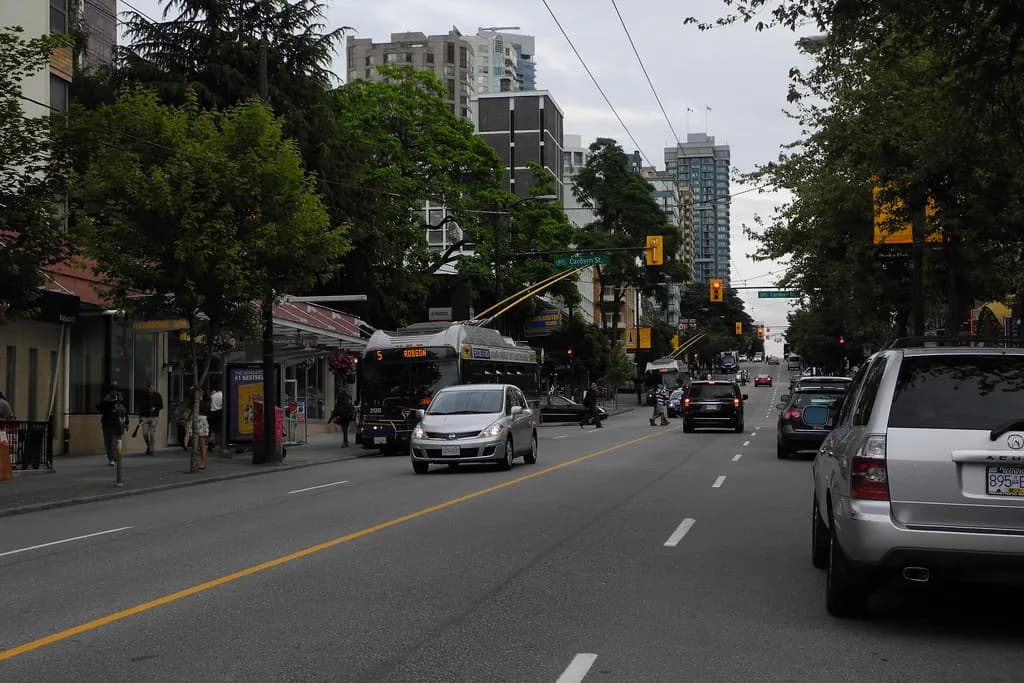
If you're located elsewhere in Canada, you must register before your first sale if you sell taxable goods, accept orders from BC customers and deliver goods into BC, and your gross revenue from sales to BC customers was more than C$10,000 in the previous 12 months or is expected to be over that in the next 12. Separate scenarios catch sellers who actively solicit BC customers (targeted ads, flyers) regardless of revenue, sellers of vapour products, anyone holding inventory in BC (including a BC fulfilment house), and anyone leasing goods in BC. Software and telecommunication sellers outside BC — including sellers outside Canada — must register once BC revenue passes the same C$10,000 mark.
Online marketplaces. If you sell through a marketplace facilitator that collects payment from your customers, the facilitator must register and collect PST on those sales. You still need your own registration for sales made through your own website, a pop-up shop or any other channel.
Real property contractors who only supply and install goods that become part of a building don't register; instead they pay PST on the materials they buy. They do have to register if they sell goods without installing them, install goods that remain movable, or have an agreement for the customer to pay the PST.
The small seller exception
You don't have to register if you are a small seller: you're located in BC, you don't sell regularly from an established commercial premises (a shop open to customers, including a home-based shop), and your gross revenue from retail sales of goods, software and services was C$10,000 or less in the last 12 months and is expected to be C$10,000 or less in the next 12. Small sellers pay PST on the supplies they buy for resale and don't charge PST to customers. A potter selling C$7,000 a year at weekend markets and online fits; the same potter opening a storefront does not, whatever the sales figure.
How to register for a PST number
Registration is free and online through eTaxBC. You'll need your legal business name and structure, your BN if you have one, owners' details, your BC business address, a description of what you sell and an estimate of your annual sales. Liquor sellers and non-medical cannabis retailers must upload extra documentation. Once approved, you receive a letter with your PST number and your reporting period.
Register for BC PST in five steps
- 1
Confirm you must (or want to) register
Check the scenarios in Bulletin PST 001. If you're a small seller you can still register voluntarily — useful if you want to buy inventory PST-free for resale.
- 2
Open eTaxBC and choose Register to collect PST
Register to collect PSTRegistration is online only. Have your business details, BN and a sales estimate ready.
- 3
Upload any required documents
Liquor-licensed premises and cannabis retailers must provide licences or approvals with the application.
- 4
Receive your PST number and reporting period
The approval letter states your PST number and how often you file. MRDT, if it applies, uses the same number.
- 5
Set up invoices and your point-of-sale
Show PST as a separate line, set the right rate for each product (7%, 10%, exempt) and record exemption documents.
Tip: If a customer can't produce an exemption document at the sale, charge PST — you can refund it if they bring the document within 180 days.
Remember that a PST number isn't a business licence. Municipal licences come from your city or regional district, and sole proprietors may also need to register a business name — see our BC sole proprietorship guide.
What's exempt from BC PST
Most goods are taxable unless an exemption applies. The everyday exemptions available to anyone, with no paperwork, are food for human consumption (groceries and restaurant meals alike, though not soft drinks or liquor), books, newspapers and magazines, children-sized clothing and footwear, bicycles, and prescription medications and common household medical aids. Other exemptions need documentation from the buyer: health and disability equipment, adult-sized clothing for children under 15, school supplies, safety equipment and protective clothing, farm and fishing inputs, purchases by First Nations individuals and bands on First Nations land, and — most important for businesses — goods bought for resale or lease.
The resale exemption is how PST avoids taxing the same item twice. A Kelowna gift shop buying stock from a wholesaler quotes its PST number, pays no PST on the stock, and charges PST when it sells to the public. If the shop then pulls an item off the shelf for its own display, it self-assesses PST on its cost.
Keep exemption records. If you don't charge PST, you must be able to show why — a PST number on the invoice, a completed certificate or other documentation. Without it, an auditor will assess the tax you didn't collect.
GST vs BC PST on common sales
| Item | GST | BC PST | Combined |
|---|---|---|---|
Adult clothing, furniture, electronics | 5% | 7% | 12% |
Children-sized clothing | 5% | Exempt | 5% |
Restaurant meal (food) | 5% | Exempt | 5% |
Wine or beer | 5% | 10% | 15% |
Basic groceries | Zero-rated | Exempt | 0% |
SaaS subscription for use in BC | 5% | 7% | 12% |
Hotel room, 3-night stay | 5% | 8% + MRDT | varies by area |
Bookkeeping or consulting service | 5% | Not taxable | 5% |
Adult clothing, furniture, electronics
- GST
5%
- BC PST
7%
- Combined
12%
Children-sized clothing
- GST
5%
- BC PST
Exempt
- Combined
5%
Restaurant meal (food)
- GST
5%
- BC PST
Exempt
- Combined
5%
Wine or beer
- GST
5%
- BC PST
10%
- Combined
15%
Basic groceries
- GST
Zero-rated
- BC PST
Exempt
- Combined
0%
SaaS subscription for use in BC
- GST
5%
- BC PST
7%
- Combined
12%
Hotel room, 3-night stay
- GST
5%
- BC PST
8% + MRDT
- Combined
varies by area
Bookkeeping or consulting service
- GST
5%
- BC PST
Not taxable
- Combined
5%
Software, digital services and telecommunications
BC taxes software at 7% when it is used on, through or with an electronic device ordinarily situated in BC, wherever the server sits and however it's delivered. The Ministry treats software as a service (a monthly subscription fee is taxable), infrastructure as a service such as cloud storage and processing capacity, web hosting and data backup, and most APIs as software. Software on a physical medium is taxed as a good instead.
Custom software developed specifically for one customer is exempt for that customer. Modified off-the-shelf software counts as custom only if the modification costs more than double the unmodified price. Software bought for resale, or built into a product you sell, is also exempt.
Businesses that use a licence both inside and outside BC can pay PST only on the BC share, using the formula PST = 7% × price × (BC use ÷ total use), generally measured over three years or the licence term if shorter. The Ministry's own example: a C$5,000 licence used on 5 of 15 devices in BC carries C$116.67 of PST. Give the seller Form FIN 443 to avoid being charged the full amount upfront, then reconcile when the period ends.
Telecommunication services — internet access, mobile and landline phones, TV services, streaming services and digital content such as music and movies — are also taxable at 7%. From 1 October 2026 the base widened: basic cable TV, residential landline telephone service and toll-free telephone service became taxable, alongside alterations and repairs to clothing and footwear and clothing patterns.
If a seller outside BC doesn't charge you PST on software or a taxable service you use here, you must self-assess it. The tax is due by the last day of the month after the purchase — buy in March, pay by 30 April, on your PST return if you're registered or on a casual return if not.
Worked example: a Toronto SaaS seller with BC customers
CloudBooks Inc. in Toronto sells a C$300-a-month accounting app. Its BC customers pay C$90,000 a year, well over C$10,000, so CloudBooks must register for BC PST. For a BC customer, place-of-supply rules make the sale a supply in a GST-only province, so each monthly invoice shows C$300 + C$15.00 GST + C$21.00 PST = C$336.00. The C$15 goes to the CRA on CloudBooks' GST/HST return; the C$21 goes to BC on its PST return.
Try it — GST + PST on a C$300 BC invoice
Professional services: what changed on 1 October 2026 — and what was paused
BC's Budget 2026 legislated PST on accounting and bookkeeping, architectural, engineering and geoscience, security and private investigation, and non-residential real estate services, scheduled to start on 1 October 2026, with PST on only 30% of the price of architectural, engineering and geoscience services. Providers were told to register up to six months early.
In September 2026 the province paused the expansion. The Ministry's Notice 2026-001 now says the measure is on hold and that accounts opened only for it should be cancelled through eTaxBC or by calling 1-877-388-4440. KPMG reported on 23 September 2026 that the pause will be carried out by a temporary regulation and that no new effective date has been announced. In short: as of October 2026, a BC accountant, engineer or property manager does not charge PST on those services. Legal services remain taxable at 7%, as they have been for years.
The other 1 October 2026 base changes — clothing repairs, clothing patterns, basic cable, residential landlines and toll-free lines — were not part of the pause and are listed as taxable in the October 2026 revision of Bulletin PST 001. If you're a tailor, shoe-repair shop or small telecom reseller, those sales now need PST.
Filing and paying your PST return
Your reporting period is assigned at registration based on the PST you expect to collect each year. Businesses that were required to register but didn't are put on monthly filing. You can ask for periods that match a 13-period fiscal year.
| PST collectable per year | Reporting periods allowed |
|---|---|
| More than C$12,000 | Monthly only |
| C$6,000 to C$12,000 | Monthly or quarterly |
| C$3,000 to C$6,000 | Quarterly or semi-annual |
| C$3,000 or less | Quarterly, semi-annual or annual |
Returns and payments are due on the last day of the month after the period ends (the next business day if that falls on a weekend or BC holiday). A registered business must file even if it made no sales — choose "Yes" for a nil return in eTaxBC. Electronic filing is mandatory if your total Canadian sales and leases were C$1.5 million or more in the last 12 months; everyone else may still mail a return, which counts as on time if Canada Post postmarks it by the due date.
The return itself has five steps: Box A, total sales and leases excluding taxes; Box B, PST collectable; Box C, your commission; Box E and F, purchases on which you must self-assess PST; Boxes H and I, PST on bad debts and refunds to customers; and Box K, the total due. File and pay in full by the due date and you keep a commission of up to C$198 per period. There is no commission on MRDT, which goes on its own return using the same period. Only one account can claim commission if you have several locations, so filing one consolidated return usually maximizes it.
Worked example: a Victoria furniture store's month
Harbour Home in Victoria files monthly. In June it sells C$90,000 of furniture before tax, all of it taxable. It refunds a customer C$140 PST on a returned sofa and buys a C$2,500 display unit from an Alberta supplier who charges no PST.
- Box A, total sales: C$90,000
- Box B, PST collectable: C$90,000 × 7% = C$6,300
- Box C, commission (filed and paid on time): C$198 (the cap)
- Box F, self-assessed PST on the display unit: C$2,500 × 7% = C$175
- Box I, PST refunded to customer: C$140
- Box K, total due: C$6,300 − C$198 + C$175 − C$140 = C$6,137, due 31 July
Its GST/HST return is separate: 5% GST on the same C$90,000 of sales, less input tax credits for the GST it paid — including the GST on that display unit, which (unlike the PST) it gets back.
Common mistakes and how to fix them
- Calculating PST on the GST-inclusive price. Both taxes use the pre-tax price. Overcharging is still a problem: any amount collected as PST must be remitted, even if it was charged in error.
- Assuming services are never taxable. Repairs, installation and maintenance of taxable goods are "related services". A computer repair shop charges PST on labour as well as parts.
- Charging PST on professional fees after 1 October 2026. The expansion is paused. If you collected PST on accounting or engineering fees, the Ministry's notice explains how to correct it and close an account opened only for that purpose.
- Not self-assessing. Equipment, software or cloud services bought from out-of-province or foreign sellers who didn't charge PST must be self-assessed. Audits find this more than anything else.
- Missing the out-of-province threshold. An Alberta or Ontario e-commerce seller crossing C$10,000 in BC sales must register before the next delivery, not at year-end.
- Filing late. You lose the commission on top of penalties and interest. Set the due date — the last day of the following month — as a recurring reminder.
If you sell into Saskatchewan or Manitoba as well, compare their rules in our Saskatchewan PST guide and Manitoba RST guide; the thresholds and filing dates are different.
Official BC PST links
- Bulletin PST 001 — Registering to Collect PSTWho must register, small sellers, out-of-province rules (Oct 2026)
- Register to collect PST (eTaxBC)Online registration
- Report and pay PSTPeriods, due dates, commission, e-filing
- Notice 2026-001 — professional servicesExpansion paused
- PST on softwareSaaS, custom software, apportionment
- PST and MRDT on accommodation8% PST, MRDT, 27-day rule
- PST exemptionsWhat's exempt and the paperwork
What to do next
Work out whether you're a small seller or must register, then set up separate PST tax codes for each rate you charge. Use the GST/HST calculator to check invoice totals, and see GST/HST rates by province for the federal side when you sell outside BC. If you're also new to the federal tax, our GST/HST guide covers registration and input tax credits.
This is general information, not legal or tax advice — confirm on the official source or with a professional.
Frequently asked questions
The general BC PST rate is 7%, charged on the price before GST. Liquor is taxed at 10%, short-term accommodation at 8% plus up to 3% MRDT in participating areas, and passenger vehicles from a dealer climb in steps from 7% up to 20% for vehicles priced at C$150,000 or more.
Yes, if you are located in BC and sell or lease taxable goods, or provide software, telecommunication, legal or related services, or accommodation in BC in the ordinary course of business. The main exception is a small seller with no established commercial premises and C$10,000 or less of taxable sales over the last 12 months and the next 12. Registration is free and done online.
Only on listed services. Legal services, telecommunication services, software, online marketplace services and related services such as repairing, installing or maintaining taxable goods are taxable. Most other services, including consulting, bookkeeping and haircuts, are not. The planned extension to accounting, architectural, engineering, security and non-residential real estate services was paused in September 2026, with no new start date.
Yes. BC treats software as a service, infrastructure as a service and downloaded software as software, taxable at 7% when used on a device ordinarily situated in BC. Custom software developed for one customer is exempt. A business using a licence both inside and outside BC can pay PST only on the BC share, using the province's apportionment formula.
The return and payment are due on the last day of the month after your reporting period ends — a July period is due 31 August. You must file even when you have nothing to report. File and pay on time and you can keep a commission of up to C$198 per period; late filers lose it and face penalties and interest.
No. Both taxes are calculated separately on the selling price. On a C$1,000 sale a BC retailer charges C$50 GST and C$70 PST, for C$1,120 in total. The GST goes to the CRA on your GST/HST return and the PST goes to the BC Ministry of Finance through eTaxBC.
Sources & verification
Figures on this page were checked against the sources below when it was last reviewed on 12 October 2026. Each rate and limit is stored once with its own official source and review date, and official update channels are monitored daily so changes are picked up. How we verify
- 1.Bulletin PST 001, Registering to Collect PST (revised October 2026) — BC Ministry of Finance · accessed 12 October 2026
- 2.Notice 2026-001, Notice to providers of professional services — BC Ministry of Finance · accessed 12 October 2026
- 3.Report and pay PST — BC Ministry of Finance · accessed 12 October 2026
- 4.Guide to Completing the PST Return — BC Ministry of Finance · accessed 12 October 2026
- 5.Accommodation (PST and MRDT) — BC Ministry of Finance · accessed 12 October 2026
- 6.Software (PST) — BC Ministry of Finance · accessed 12 October 2026
- 7.PST exemptions — BC Ministry of Finance · accessed 12 October 2026
- 8.Bulletin PST 308, PST on Vehicles (revised August 2026) — BC Ministry of Finance · accessed 12 October 2026
- 9.Charge and collect the tax – Which rate to charge — Canada Revenue Agency · accessed 12 October 2026
- 10.British Columbia pauses PST expansion to professional services — KPMG · accessed 12 October 2026
MSMETOOLS is an independent platform and is not affiliated with any government agency, ministry or department.
Tools for this
GST/HST Calculator (Canada)
Calculate GST, HST and PST by province.
Invoice Generator
Create professional invoices with tax, logo and custom details.
Sales Tax Calculator (US)
Calculate sales tax for all US states and cities.
Related guides
 Manitoba PST (RST) 2026: 7% Rate, Registration & FilingRead guide
 Saskatchewan PST 2026: 6% Rate, Registration & ContractorsRead guide
 GST/HST Rates by Province 2026: Table, PST/QST & ExamplesRead guide
 How to Calculate HST in 2026: Add, Remove & ReverseRead guide
Official links open the government site in a new tab.